How water treatment works, in plain words.
Three short, simplified explainers, and the words you’ll meet when you choose a system.
Ask us about your water on WhatsAppThree explainers
-

How reverse osmosis works
Water passes. Most salts don’t. Raise the pressure and watch the flow turn round.
-
How a softener works
Tiny resin beads swap the minerals that cause scale for sodium.
-
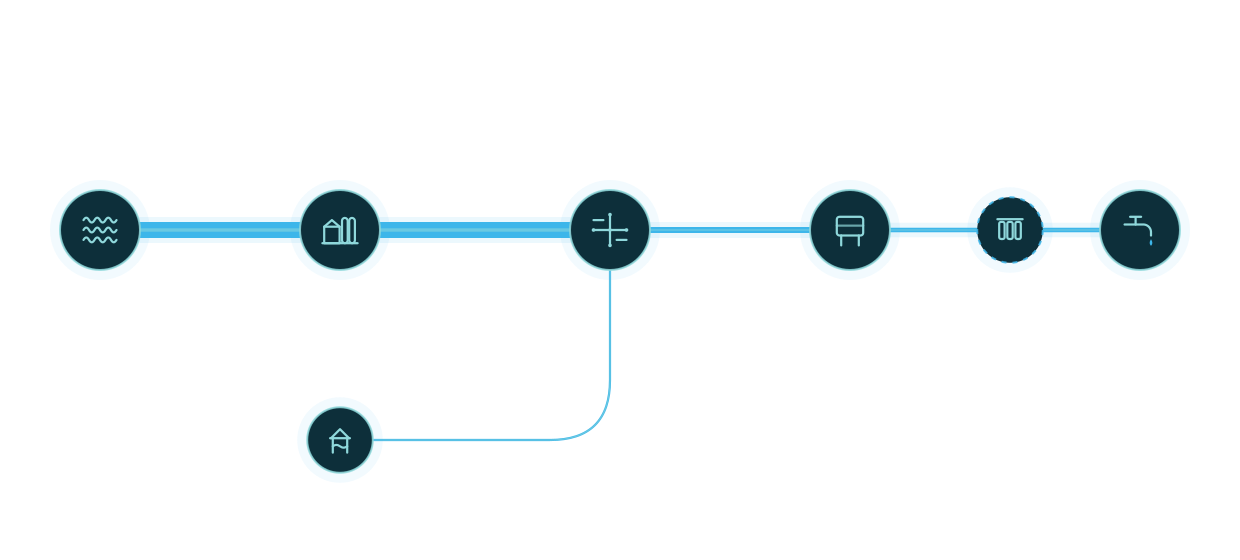
Water in Oman
Where the public water supply comes from, with the 2024 figures.
Simplified
Words you’ll meet
- Reverse osmosis (RO)
- A very fine membrane that holds back most dissolved salts while water is pushed through it under pressure.
- TDS
- Total dissolved solids: the amount of minerals and salts dissolved in water.
- GPD
- US gallons per day: how much treated water a unit or a plant can make in a day. Ask us about the amount you need.
- Softener
- A unit that swaps the minerals that cause scale for sodium, on tiny resin beads.
Read more
- Osmosis
- Water moving through a membrane towards the saltier side.
- Membrane
- A very thin sheet that lets water through and holds back most dissolved salts. In a purifier it is rolled up inside a cartridge.
- Pre-treatment
- The first stages, which catch sand and particles so the membranes last longer.
- Concentrate
- The water that carries away what the membrane holds back, through the drain line.
- Scale
- The hard, chalky layer that hard water leaves in pipes, heaters and appliances.
- Resin
- The tiny beads inside a softener that catch the minerals that cause scale.